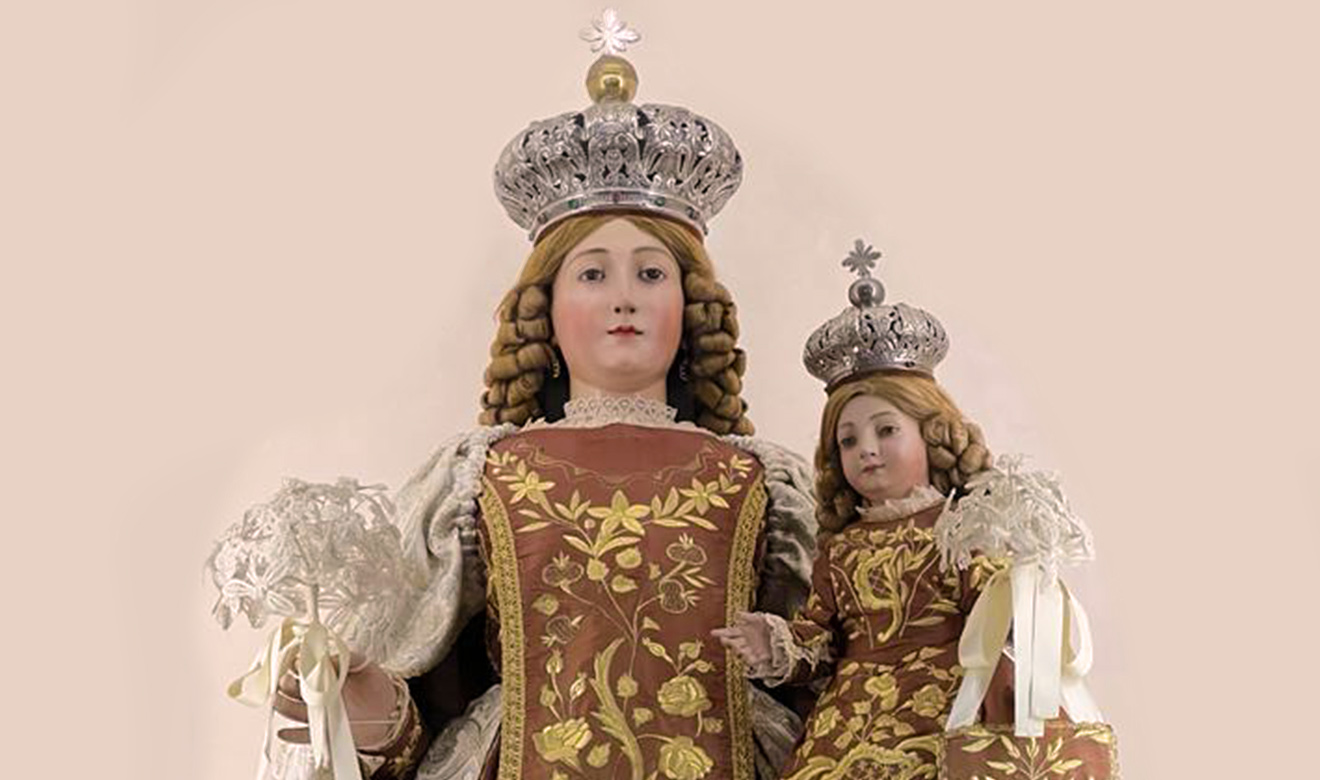
For time immemorial, Mesagne has held a profound popular devotion to Our Lady of Mount Carmel. The various forms of worship and celebrations within the sanctuary of this Apulian town are diverse, stemming from the deep devotion and popular cult towards Our Lady of Mount Carmel in Mesagne.
Closely tied to the workship of the Virgin of Carmel, Mesagnesi affectionately refer to her as “Our Lady” since 1743 when, through her intercession, they were protected from a devastating earthquake that struck the region. The liturgical feast of “Our Lady” in Mesagne was established to commemorate the Marian apparition that occurred on July 16, 1251, to Saint Simon Stock. During this event, the Madonna revealed significant privileges connected to devotion.
The celebration in Mesagne unfolds over three days, marked by processions and devotion. To understand the historical development of the cult, it is necessary to gather and analyze sources that trace the real events associated with the rise of the cult, distinct from often legend-infused narratives. This journey takes us through historical stages up to the present day, genuinely reconstructing the Marian devotion of the Mesagne population.
Before the reconstruction of the Mother Church (collapsed in 1649, with the laying of the first stone for reconstruction on August 28, 1650, and reopened for worship in 1660), Mesagne celebrated both the feast of Santa Maria del Carmine and the feast of Saint Eleutherius. Indeed, due to a misinterpretation of certain writings, the Patronage of St. Eleutherius was maintained until 1651 when Our Lady of Mount Carmel was elected as the principal patroness, protectress, and advocate. The aura of miracles and wonders surrounding the image of Our Lady of Mount Carmel captivated the popular spirit, leading to her elevation as the Patroness of the town on April 30, 1651.
Since then, celebrations in honor of Our Lady have continued, evolving into an annual festival of entertainment in the early 1900s when there were limited amusements. The festival became an annual showcase of elegance and fashion, with people renewing their wardrobes, engaging all the tailors and shoemakers in the town. The festivities took place in the open spaces of Porta Grande, Villa Comunale (which was then a grassy area), and along Via della Stazione. Illuminations, fireworks, and music have played a significant role in the celebration from its origins.
Today, Mesagne still celebrates the festival in honor of Our Lady of Mount Carmel, with the Mother Church serving as the center of religious life and Mesagne’s history. Until 1930, it was the only parish in the city and, until a few years ago, the seat of the College of Mesagne priests, hence called “Insigne Collegiata.” The 24 stained glass windows distributed along the perimeter create a luminous atmosphere. In the majestic Bell Tower, the so-called “old Big Bell,” cast in 1752, is tuned to the musical note D and bears relief images of Saint Eleutherius and Our Lady of Mount Carmel.
Many instruments that Mesagne’s people still possess today—prayer and devotion booklets, novenas, images of Our Lady, poems, and songs—constitute a rich and varied heritage of the town’s culture and religiosity. These aids and tools, placed in the hands of the faithful, represent the expression of a typical popular religiosity born outside the Church’s rituals, making it even more heartfelt. Therefore, it is crucial to ascertain the historical, religious, and cultural origins of the devotion to Our Lady, which in Mesagne is considered among the practices most directly connected to popular contexts of reference.